


The crypto industry continues to evolve, and as it does, so do its complex tax implications. While once a niche investment, cryptocurrencies have become a significant financial asset for many individuals, leading to increased scrutiny among tax authorities. And the intersection between crypto and tax laws can quickly become a tangled web.
In this guide, we demystify the complex world of crypto taxes by addressing some of the most frequently asked questions – especially those surfacing in 2024.
Wat komt er in 2024?
New Tax Brackets
The IRS’ most significant change impacting crypto investors is the updated tax brackets. In 2024, the income limits for these tax brackets will increase to adjust for inflation. Meanwhile, the standard deduction will increase by $750 for single filers and $1,500 for joint filers.
| Tax Rate | Enkele bestanden | Getrouwd, gezamenlijk indienen | Hoofd van het huishouden |
| 10% | $ 0 tot $ 11,600 | $ 0 tot $ 23,200 | $ 0 tot $ 16,550 |
| 12% | $ 11,600 tot $ 47,150 | $ 23,200 tot $ 94,300 | $ 16,550 tot $ 63,100 |
| 22% | $ 47,150 tot $ 100,525 | $ 94,300 tot $ 201,050 | $ 63,100 tot $ 100,500 |
| 24% | $ 100,525 tot $ 191,950 | $ 201,050 tot $ 383,900 | $ 100,500 tot $ 191,950 |
| 32% | $ 191,950 tot $ 243,725 | $ 383,900 tot $ 487,450 | $ 191,950 tot $ 243,700 |
| 35% | $ 243,725 tot $ 609,350 | $ 487,450 tot $ 731,200 | $ 243,700 tot $ 609,350 |
| 37% | $ 609,350 of meer | $ 731,200 of meer | $ 609,350 of meer |
Form 1099-K Phase-In
IRS Let op 2023-74 delayed the new $600 Form 1099-K reporting threshold for third-party settlement organizations for the calendar year 2023. In 2023, the only exception applied to taxpayers receiving over $20,000 with more than 200 transactions in 2023.
However, the IRS is planning a threshold of $5,000 for tax year 2024 as part of a phase-in to implement the $600 reporting threshold enacted under the American Rescue Plan (ARP).
NFT Collectibles Tax
IRS Let op 2023-27 requested comments on any aspect of non-fungible tokens (NFTs) that might affect the treatment of an NFT as a collectible. In addition, the agency noted that it would determine if an NFT is collectible by using a “look-through analysis.”
NFT holders should keep an eye on these comments and any final ruling while potentially reclassifying their NFT sales if they want to take a conservative stance in 2024.
Beloningen uitzetten
IRS Inkomstenregeling 2023-14 clarified the treatment of crypto staking rewards, saying you must include them in your gross income for the taxable year you acquired “dominion and control” over the awarded cryptocurrency rather than when it’s issued.
Belastingverlies oogsten
crypto belastingverliezen oogsten has become a buzzword over the past few years. As “property,” crypto-assets don’t explicitly fall under the Wash Sale Rule. But it’s becoming increasingly clear that the loophole is bound to close soon.
Veelgestelde Vragen / FAQ
Hoe u cryptovaluta kunt aangeven bij de belastingdienst
Crypto taxes generally fall under income or capital gains tax categories.
For example, if you earn cryptocurrency from mijnbouw as a hobby, you typically report the total value of the mining rewards as “other income” on Form 1040 Schedule 1. On the other hand, if you mine cryptocurrency as a business, you might report the income and expenses on Form 1040 Schedule C or other corporate tax forms (e.g., Form 1120).
You typically report the capital gains and losses on Form 8949 if you earn interest or sell cryptocurrency for a profit. You must record each transaction’s date, description, proceeds, and cost basis. Then, you will add these totals to generate a comprehensive capital gain or loss reported on Form 1040 Schedule D.
Hoe cryptobelasting te berekenen
The amount of tax you owe on crypto transactions depends on several factors.
On Form 8949, transactions fall into long-term and short-term categories. Long-term transactions (held for over a year) fall under the long-term capital gains tax rate between 0% and 20%. On the other hand, short-term transactions (held for less than one year) are ordinary income subject to a much higher 10% to 37% tax rate.
Cost basis calculations play a similar role in determining how much you owe. By default, the IRS assumes you use a first-in, first-out (FIFO) approach, matching each sale with the earliest purchase transaction. This approach maximizes the chance that you have a long-term capital gain since it’s necessarily the longest time between transactions.
However, FIFO isn’t always the best approach. For example, a short-term trader who never holds anything for longer than a year might want to minimize profit rather than maximize time. In that case, a highest-in, first-out (HIFO) might lessen their tax exposure. This approach minimizes the profit per transaction, reducing the absolute tax amount.
How to File Crypto Taxes
Filing crypto taxes is becoming a lot easier thanks to crypto tax software.
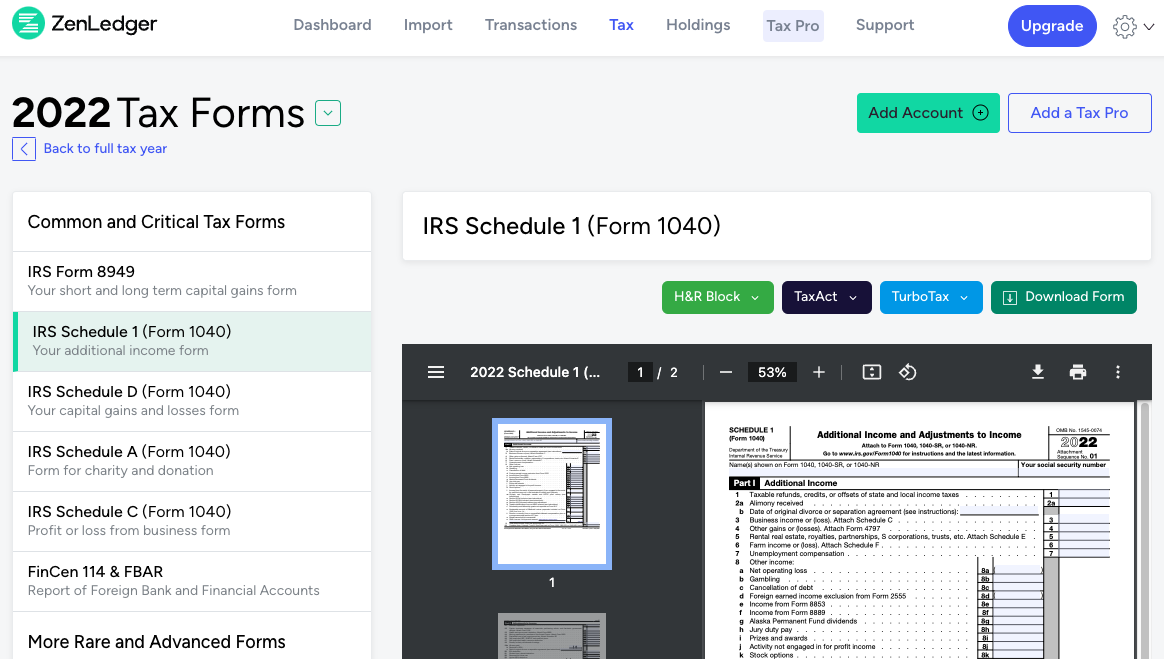
ZenLedger connects to your exchanges and wallets, aggregates all transactions, computes your capital gain or loss, and generates the paperwork you need to file (e.g., Form 8949, Schedule D, etc.). You can even complete your entire personal tax e-filing without leaving the ZenLedger app through a new partnership with April or integrate with platforms like TurboTax.
If you have more complex crypto taxes, it may be a good idea to seek the advice of a tax professional. A CPA or other tax professional can help you minimize your tax liability, such as deciding how much to gift or when to sell a large holding.
How to Claim Crypto Losses on Taxes
Nobody wants to lose money investing in cryptocurrencies. But if you do, you can typically use some of those losses to offset any capital gains and up to $3,000 of ordinary income.
Going a step further, you can use tax-loss harvesting to systematically reduce your tax obligations by strategically selling losing positions to realize their losses. However, the IRS is increasingly keen on closing the loophole, allowing crypto traders to reinvest in the same asset immediately, so watch for potential rule changes in 2024.
How to Avoid Crypto Taxes
The IRS continues to invest in cracking down on those evading crypto taxes. So, it’s never a good idea to fail to report crypto transactions in order to avoid paying taxes.
That said, there are a handful of ways you can legally reduce the amount you owe, including:
- Invest in an IRA. Crypto IRAs provide the same benefits as conventional IRAs. With a traditional IRA, you can reduce your taxable income by the amount you contribute in the current year. And with a Roth IRA, you can avoid paying future capital gains.
- Increase Holding Time. Holding crypto assets for longer than one year will kick in the long-term capital gains tax rate, which is significantly lower than the short-term rate – especially for higher-income individuals.
- Gift Crypto to Family Members. Gifting crypto assets resets the cost basis, making it a great way to avoid paying crypto taxes. You can currently gift up to $17,000 per person per year before filing a gift tax return.
- Sell During Low-Tax Years. Your capital gains or ordinary income tax rates depend on your income for the year. If you have uneven income streams, consider selling during a low tax year to pay less in taxes.
- Doneer cryptogeld – Donating crypto assets can provide tax deductions if you itemize your tax return. But with the standard deduction rising to $14,600 (single) and $29,200 (married, filing jointly), you should make sure that it makes sense to itemize before.
How to Report Crypto Staking Rewards
Ethereum and other blockchains are moving toward proof-of-stake (PoS) consensus mechanisms, which have shifted income from mining rewards to staking rewards.
. Ethereum introduced its staking rewards, stakers could earn awards they couldn’t sell until they unlocked them. As a result, it was unclear whether they owed tax on the awards when they were received.
The IRS Revenue Ruling 2023-13 clarifies that taxpayers don’t owe any tax until they have dominion and control over their assets. In other words, they must be able to sell or otherwise transfer the asset before they owe taxes on it. But they must report the staking income on their tax return as ordinary income on that date.
The Bottom Line
Crypto taxes continue to be a hot-button issue for regulators. At the same time, they can be stressful and confusing for individuals and businesses. If you have questions above and beyond what we’ve covered, it’s a good idea to seek the advice and guidance of a CPA or other tax professional to help you make the best decisions.
If you want to streamline your taxes in 2024, consider using ZenLedger to aggregate transactions, compute capital gains, and generate the paperwork you need.
Het bovenstaande is uitsluitend bedoeld voor algemene informatiedoeleinden en mag niet worden geïnterpreteerd als professioneel advies. Vraag onafhankelijk juridisch, financieel, fiscaal of ander advies dat specifiek is voor uw specifieke situatie.


